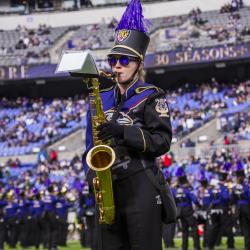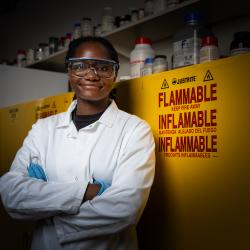
Meet the Science Terps Marching in the Baltimore Ravens’ Band
Charlotte Norris and Andrea Zeppuhar take their musical talents to M&T Bank Stadium.
For Charlotte Norris (B.S. ’24, geology), graduating from the University of Maryland meant big changes. As a student, she filled her time with geology and band. She played piccolo in the Mighty Sound of Maryland (MSOM)—UMD’s marching band—where she formed a strong community of friends. But after graduation, she worried she might lose all that.
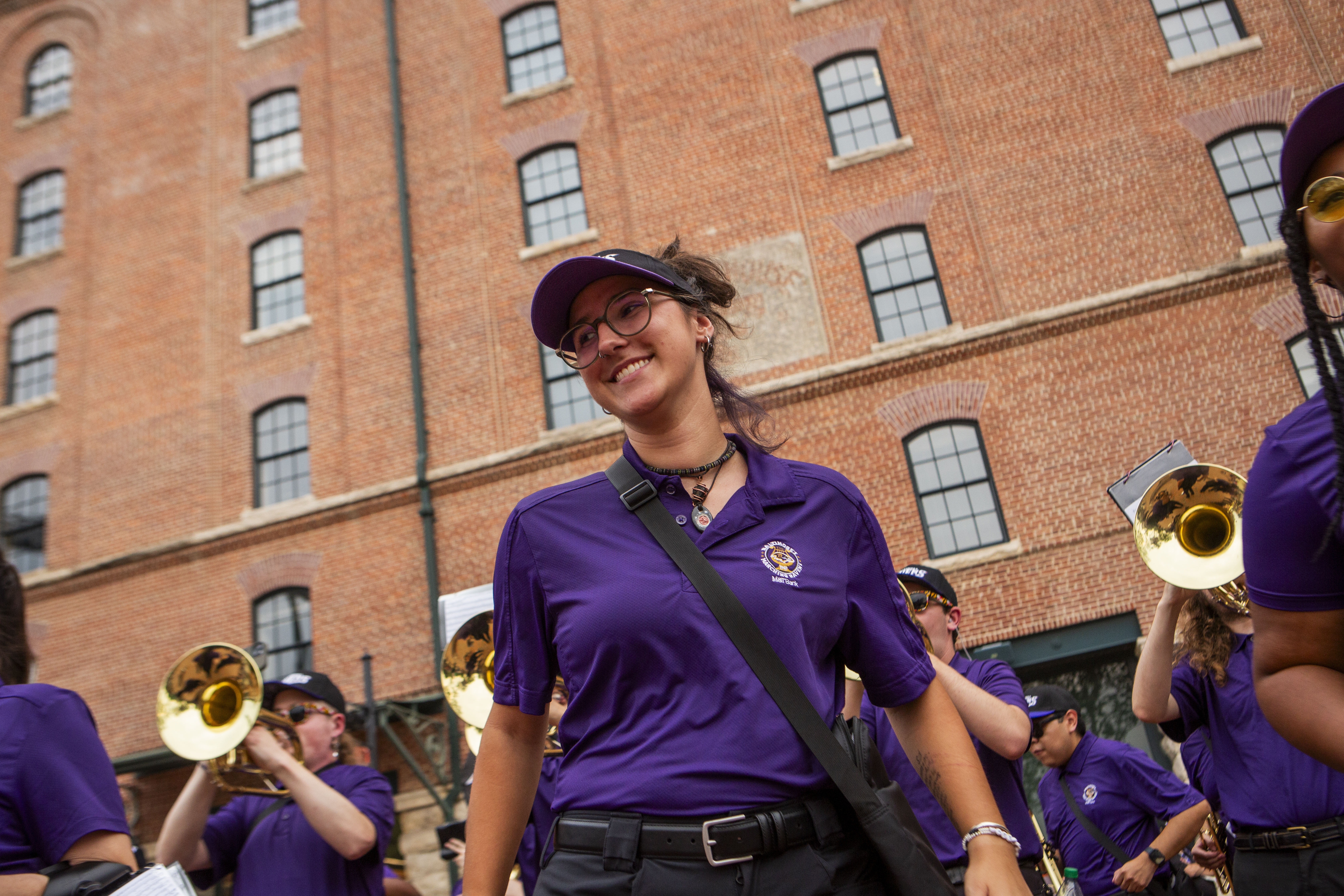
“Post-college, I was really worried about maintaining something for myself outside of work and having people I could call my friends,” Norris said. “So many people told me that it’s hard to make friends in your adult life, and I didn’t want that to happen to me.”
Luckily for Norris, shortly after leaving College Park, she found Baltimore's Marching Ravens—a group of more than 150 musicians and equipment crew members who play at Baltimore Ravens home games and the largest musical organization associated with the National Football League. Now entering her second year playing piccolo with the group, Norris has cultivated a strong community there—and she hopes it’s just the start of a long tenure.
“We have a wonderful group of people,” Norris said. “I cannot recommend it more.”
The opportunity to play at NFL games doesn’t come every day. The Ravens are one of only two teams in the league with a full marching band (the other is the Washington Commanders). During home games, the group plays a pregame show outside the stadium and then entertains fans in the stands throughout the game and on the field for a pregame or halftime marching performance. They also play at Fourth of July parades and in small-group performances at special events, including festivals, markets, bar mitzvahs and corporate gatherings. Depending on how far the Ravens advance in the postseason, the band could be active for nearly a calendar year.
Spending so much time together forges a strong community, said Andrea Zeppuhar (Ph.D. ’21, chemistry), a tenor saxophonist who is entering her second season with the band.
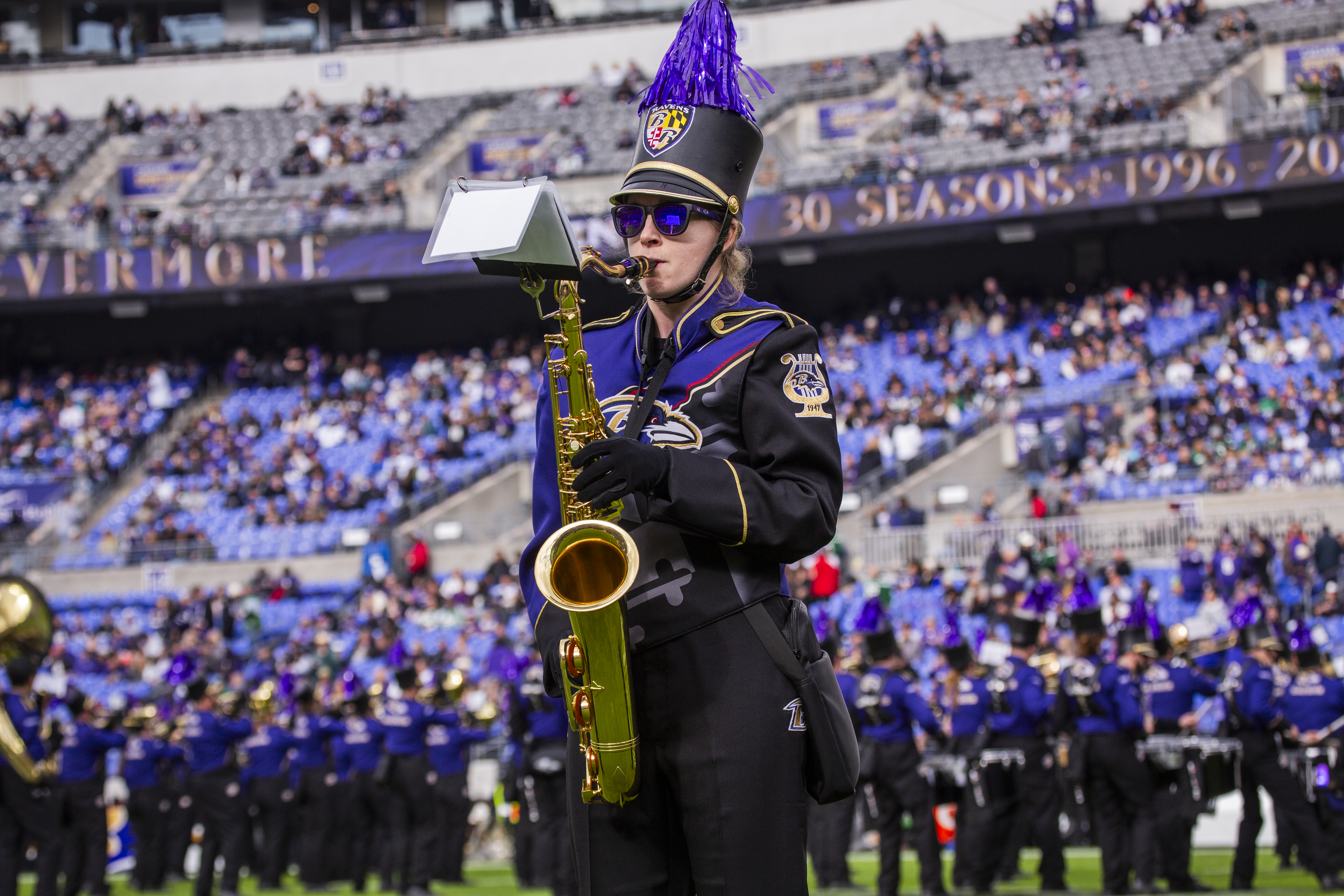
“I felt like I walked into a family,” she said.
The relationships Zeppuhar built in the band have made the hard work worth it—and for her, earning a spot required hours of dedication. Before deciding to audition for the Ravens band, she hadn’t played her saxophone for eight years while she was in graduate school because her small apartment had thin walls, and she didn’t want to disturb the neighbors. Plus, she hadn’t marched since high school. Zeppuhar spent a year shaking off the rust by playing an electronic saxophone through headphones at home and practicing on her actual saxophone at her friend’s house. She eventually got into the group, and the hard work hasn’t stopped there.
Before and during the football season, Baltimore’s Marching Ravens rehearse once a week for about three hours. Game days can require an additional 10-12 hours. Band members report to the Ravens’ practice facility in Owings Mills five hours before kickoff and then bus to M&T Bank Stadium for gameday performances. For prime-time games such as Monday Night Football, which can kick off after 8 p.m. on weekdays, Zeppuhar has to take time off work and often doesn’t get home until 2 a.m.
Zeppuhar says she’s fortunate that her employer, the Johns Hopkins University Applied Physics Laboratory, is supportive of her role in the band. She works her nine-to-five as a synthetic chemist specializing in making small molecules and polymeric materials. The work builds off her Ph.D. research in organic photochemistry, advised by Chemistry and Biochemistry Chair Daniel Falvey, and her postdoctoral research in materials synthesis with Chemistry and Biochemistry Assistant Professor Mercedes Taylor.
Norris, meanwhile, is a staff geologist with ARM Group, an environmental consulting firm. She manages and conducts groundwater sampling at the largest brownfield remediation site in North America. She, too, recognizes the challenges of balancing work with band. Luckily for her, it’s a skill she honed as a student at UMD. Back then, MSOM rehearsed for about eight to 10 hours per week. Plus, they traveled for basketball games.
“I’ve set this precedent of filling my time with band, and now I’m just continuing to do that,” Norris said. “I have band, and I have geology—my two lives.”
Now that Norris is in Baltimore’s Marching Ravens, she wants to stay for as long as possible.
“I can’t imagine a world where I’m not doing Ravens band,” she said.
Zeppuhar feels the same way.
“I know I’m not going to be able to sustain this forever, but it’s such a great environment that I want to stay in as long as I can,” she said.