UMD’s Pratyush Tiwary Receives $902K Grant to Develop Energy-Efficient AI for Chemical Sciences
The three-year award from the U.S. Department of Energy is a second renewal, bringing the total over nine years to $2.3M.
Pratyush Tiwary, a professor in the Department of Chemistry and Biochemistry at the University of Maryland who also holds the Millard and Lee Alexander Professorship in Chemical Physics, received $902,000 from the U.S. Department of Energy (DOE) for the second renewal of a 2020 Basic Energy Sciences award to develop efficient, explainable and extrapolative artificial intelligence (AI) tools for condensed phase molecular systems.

The award, which includes a 30% budget increase from the previous period, brings Tiwary’s total support from DOE for this work to $2.3 million over nine years.
In earlier phases of the project, “our team built AI tools that help computer simulations find the molecular motions that matter most,” said Tiwary, who holds a joint appointment in the UMD Institute for Physical Science and Technology and leads therapeutic drug discovery research at the University of Maryland Institute for Health Computing (UM-IHC).
“These tools make it easier to study rare events—such as the first steps of crystal formation—that normally take too long to observe with standard simulations,” said Tiwary. “By closing the gap between theoretical physics and experimental chemistry, we can do calculations often inaccessible to physical lab equipment.”
Today’s AI chemistry models are often brittle, working only for the temperatures, pressures, chemical types and other factors used in the model’s training. In addition, “in chemistry, moving to a new condition can require new data, expensive simulations and a new model,” Tiwary said.
With data and energy efficiency now paramount in the world of AI, Tiwary’s team will turn its focus to “leaner” physics-informed models, which can learn from less data, use less computation and predict reliably far beyond the settings in which they were first developed.
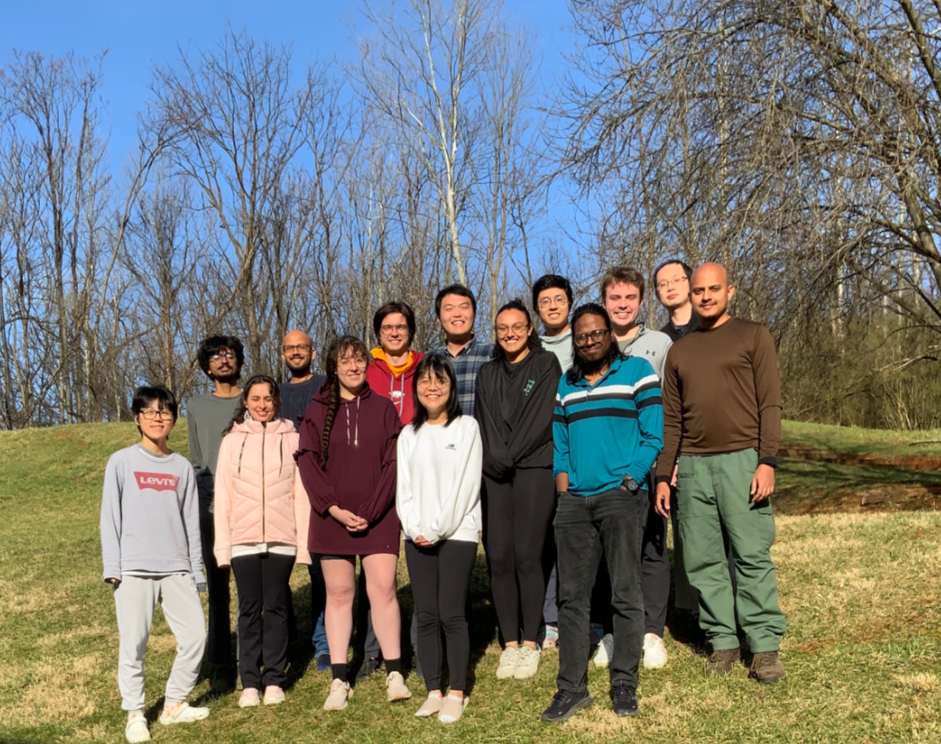
“Building thermodynamics and statistical physics into AI taps into these benefits,” he said. “And because such gains must be trusted, our process also asks how the model learned, not just what answer it produced. This is part of our group’s long-term effort to build robust, trustworthy and energy-efficient AI-powered science.”
Broadly, Tiwary conducts interdisciplinary theoretical and computational research to model and predict thermodynamics, dynamics and their interplay in complex real-world systems. The research is relevant to pharmaceutical, chemical and materials sciences.
The funding renewal comes through DOE’s Basic Energy Sciences program, which supports basic research behind a broad range of energy technologies spanning energy generation, conversion, transmission, storage and use. The new work will utilize the team’s latest methods, including latent thermodynamic flows they described in the Royal Society of Chemistry’s Chemical Science Journal in 2026. The team will also target areas of increased chemical complexity, such as crystal nucleation, which they published a study on in the Proceedings of the National Academy of Sciences in 2025.
“I’m grateful for DOE’s extended support, which lets us continue to use what we’ve learned and developed to push AI applications to the next level,” Tiwary said. “We think our work can contribute meaningfully to DOE’s mission of creating and deploying AI models that enable the future of energy sciences.”