Chemistry and Biochemistry Professor John Fourkas Named 2026-27 Distinguished Scholar-Teacher
A pioneer in ultrafast laser science, the physical chemist has spent 20 years pushing boundaries in both research and teaching at UMD.
University of Maryland Chemistry and Biochemistry Professor John Fourkas has been recognized as a 2026-27 Distinguished Scholar-Teacher, one of UMD’s highest faculty honors.

“Dr. Fourkas is a world-renowned scientist and scholar who cares passionately about educating students at the undergraduate and graduate levels,” said Daniel Falvey, chair of UMD’s Department of Chemistry and Biochemistry. “It is hard to imagine a more suitable candidate for this recognition.”
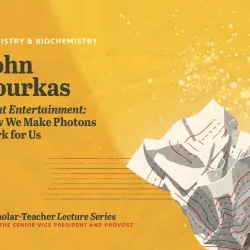
Established in 1978, the Distinguished Scholar-Teacher Program honors faculty members who have demonstrated notable success in both scholarship and teaching. Distinguished Scholar-Teachers receive an honorarium of $5,000 to support their research and mentoring activities and give a public lecture during the academic year on a topic within their scholarly discipline. Fourkas plans to deliver his lecture, titled “Light Entertainment: How We Make Photons Work for Us,” on November 4, 2026.
“It’s truly a thrilling moment in my career to receive this recognition,” said Fourkas, who has a joint appointment in the Institute for Physical Science and Technology and holds the Millard Alexander Professorship in Chemistry.
Fourkas joined UMD in 2005, after spending a decade as a faculty member at Boston College. His research centers on ultrafast lasers that generate pulses of light that last femtoseconds—just a few millionths of a billionth of a second—and their applications in nonlinear optics, where the behavior of light depends on its intensity raised to a higher power. As an internationally recognized expert and leader in the field of optics and photonics, Fourkas’ research revolutionized how scientists can observe and work with materials at the microscopic level.
Among his lab's most notable contributions is foundational work in multiphoton 3D microprinting, a technique that uses tightly focused laser pulses to cure photosensitive materials point-by-point—enabling the fabrication of microscale three-dimensional structures with high precision. Fourkas's group was among the first in the world to develop and apply this technology, which his lab has since extended to cellular biophysics, microfluidics and potentially semiconductor fabrication.
“The team has a really broad set of research interests. There’s that unifying theme of nonlinear optics, but we’re very interdisciplinary,” Fourkas said. “My background is in physical chemistry, but we also do many things in biology, materials science, nanotechnology and imaging. We collaborate with a lot of different people across campus and the globe.”
Fourkas has authored or co-authored over 180 peer-reviewed journal publications, appearing in journals including Science, Nature and the Proceedings of the National Academy of Sciences—along with 15 book chapters and three edited books, accumulating more than 11,500 citations and an h-index of 60. He holds 16 patents and is a Fellow of the American Association for the Advancement of Science, the American Physical Society, Optica and SPIE.
Over his career, Fourkas has mentored more than 50 undergraduates—five of whom were named Beckman Scholars—and published 29 papers with undergraduate co-authors. The 31 Ph.D. students Fourkas advised hold faculty positions at universities and work at the U.S. Food and Drug Administration and companies including Intel and Meta.
In 2016, Fourkas helped launch UMD’s Professional Research Experience Program (PREP) with the National Institute of Standards and Technology. The program connects researchers at the two institutions, and currently funds over 100 participants, including 15 graduate students and 12 undergraduates.
As an educator, Fourkas teaches undergraduate and graduate courses in quantum chemistry, statistical mechanics and general chemistry. Earlier in his teaching career, he developed a graduate course in instrument interfacing using LabVIEW, a graphical programming language widely used in scientific settings, which bolstered the research productivity of numerous graduate students and has been taught regularly by Fourkas and Chemistry and Biochemistry Professor Amy Mullin ever since. He also redesigned UMD’s undergraduate bioanalytical laboratory course (CHEM 277), introducing miniaturized computer-interfaced instrumentation and a student-designed experiment module in which small groups develop and execute their own research proposals.
As Associate Chair for the Graduate Programs in the Department of Chemistry & Biochemistry, he shaped curricula for all incoming Chemistry graduate students and developed a two-course professional skills sequence covering research ethics, scientific writing, library resources and university support systems.
Beyond the classroom, Fourkas serves as the Associate Dean for Faculty affairs in the College of Computer, Mathematical, and Natural Sciences, where he oversees the tenure and promotion process for the college’s over 300 tenure-line and 750 professional-track faculty members, advises junior faculty members, and works to standardize practices across the College's Departments. He is also currently the Interim Associate Provost for Faculty Affairs.
Fourkas earned his B.S. and M.S. in chemistry from the California Institute of Technology in 1986 and his Ph.D. in physical chemistry from Stanford University in 1992.