Professor Emerita Janice Reutt-Robey Creates Faculty Support Fund in Chemistry and Biochemistry
Reutt-Robey and her husband are providing flexible support to a faculty member with an exemplary research record and commitment to mentoring graduate students.
After 38 years on the University of Maryland faculty—including 13 years as chair of the Department of Chemistry and Biochemistry—Professor Emerita Janice Reutt-Robey continues to invest in the department and the people who make its work possible.
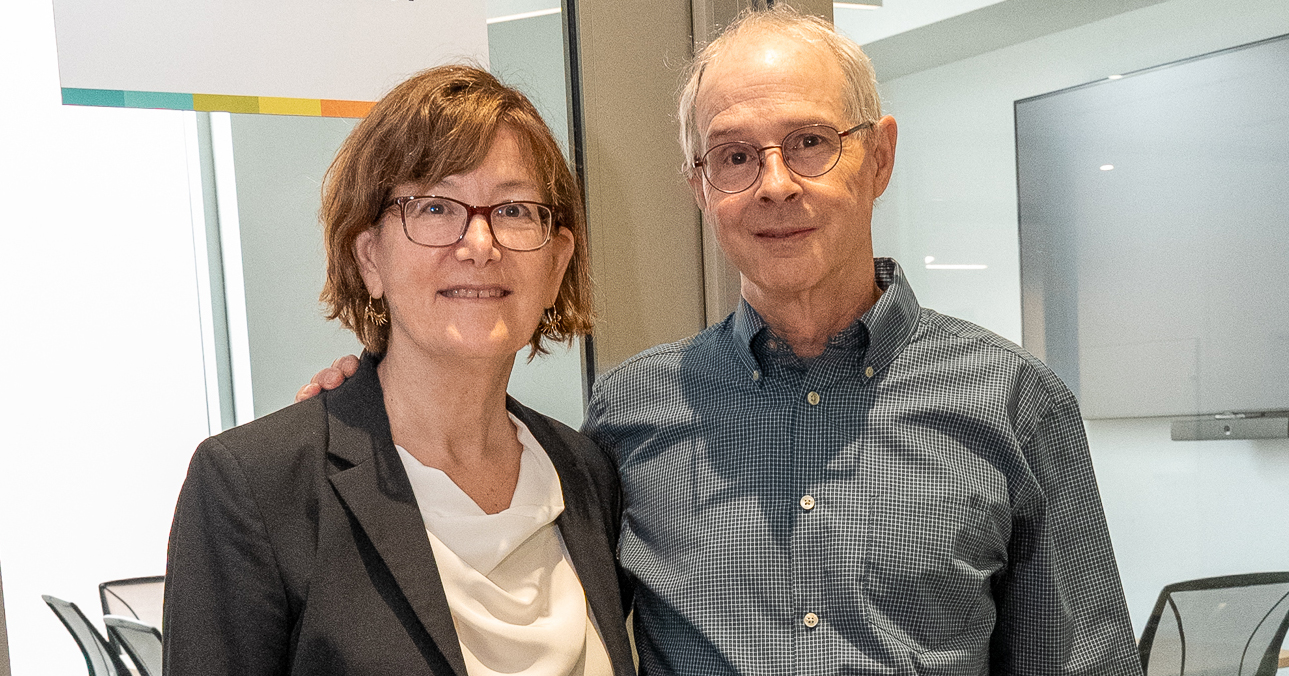
She and her husband established the Janice Reutt-Robey and Steven Robey Endowed Faculty Support Fund in Chemistry and Biochemistry. The fund will provide flexible support to a department faculty member with an exemplary research record and commitment to mentoring graduate students.
“The vitality of faculty research programs, which provide training opportunities that transform student lives, is absolutely key to UMD’s research mission,” Reutt-Robey said. “My husband and I were very much inspired by the impact that faculty endowments, such as the Millard and Lee Alexander Professorship and the Nathan Drake Faculty Fellowship, have had on the department’s research and education programs.”
The fund will support research expenses, giving the recipient discretionary funds to advance their research program through materials and instrumentation, student support, professional development, and other activities that advance faculty scholarship.
“The flexible funds provided by Janice and Steve's gift will be immensely important to the future of the department,” said Daniel Falvey, chair of the Department of Chemistry and Biochemistry. “Federal grants and industry contracts tend to come with very stringent restrictions on how they can be used. The Reutt-Robey Fund will be used to help faculty members and their students explore novel areas of research that have not yet made it onto the radar screen of traditional funding agencies. The fund can also be used to support students attending conferences or obtaining specialized training that would not be possible with restricted grant funds."
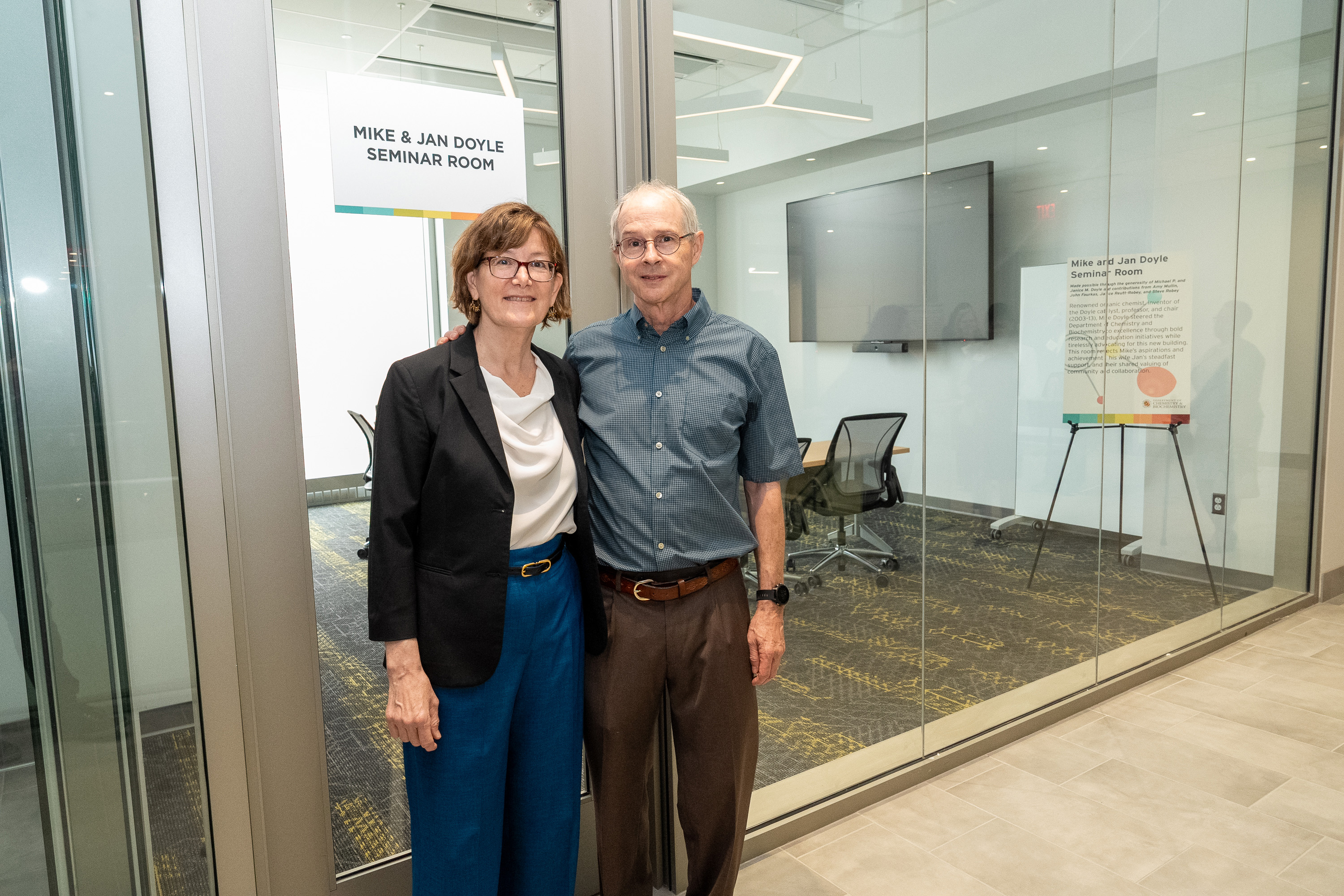
The new fund builds on Reutt-Robey and Robey’s earlier support for student groups and in helping name the Mike and Jan Doyle Seminar Room in the new Chemistry Building, which opened in 2024, in recognition of Mike Doyle’s contributions as a professor and chair of the department from 2003 to 2013.
“Janice Reutt-Robey has made an extraordinary impact on the Department of Chemistry and Biochemistry through her leadership, scholarship, mentorship and generosity,” said Amitabh Varshney, dean of the College of Computer, Mathematical, and Natural Sciences (CMNS). “We are grateful to Janice and Steven for their latest gift, which reflects their deep understanding that investing in faculty is essential to advancing discovery and preparing the next generation of scientists.”
Reutt-Robey and Robey’s philanthropy supports Forward: The University of Maryland Campaign for the Fearless, a $2.5 billion fundraising initiative that aims to expand access to UMD’s world-class education, accelerate groundbreaking research and build stronger communities.
Catalyzing success
Those who know Reutt-Robey are not surprised that her gift emphasizes faculty members committed to student mentorship. Throughout her career, she mentored more than 30 graduate students and postdoctoral researchers, many of whom have gone on to faculty positions and careers at national laboratories and corporations across the country. She encouraged students to pursue independence and collaboration while recognizing that success can take many forms.
“Not everyone has the exact same goals,” she said. “I like to be open-minded about what success looks like for each person. For example, Ph.D. research is about accomplishing, but it’s also about exploring and testing yourself to find what really is important and what you really find interesting. There’s no one path to success in that way.”
Reutt-Robey spent much of her career strengthening Maryland’s capacity for rigorous, cutting-edge research in the chemical sciences. As department chair, she recruited 22 new tenure-track and professional-track faculty members, and the department’s annual sponsored research funding doubled. She also helped secure over $2.5 million in philanthropic support for endowed spaces and lectures, as well as student and faculty programs.
She oversaw the development of nine chemistry teaching labs in the Edward St. John Learning and Teaching Center that opened in 2017 and the construction of the new 105,000-square-foot Chemistry Building. The building now serves as a hub for quantum chemistry, molecular nanoscience and sustainability research.
“I’m glad to have been part of the effort to build this modern infrastructure we see around us today,” Reutt-Robey said. “The department’s capacity to do research now is much greater. We’re better equipped to solve problems and ask new questions about our natural world.”
She also oversaw the department’s launch of a B.A. degree in chemistry, intended for students pursuing K-12 teaching certifications or degrees in other related fields such as business, public policy and public health. She focused on student advocacy by supporting the revival of the department’s graduate student organization, implementing numerous fellowship programs, and championing groups like the National Organization of Black Chemists and Chemical Engineers (NOBCChE) and the Society for Advancement of Chicanos and Native American Students (SACNAS). At the college level, she chaired the CMNS Diversity and Inclusion Advisory Council from 2020 to 2025.
“Having a community and fostering that sense of belonging is incredibly important, especially now. These activities and organizations support diverse perspectives and provide professional opportunities that benefit everyone,” she noted. “We have a very different student body now than when I first came to UMD, people from all sorts of backgrounds with different skills. It’s important to support all students so that they can thrive at UMD and beyond.”
Pioneering research at surfaces and interfaces
As a surface chemist, Reutt-Robey understands how the right tools can shape discovery. Her research has focused on developing sophisticated techniques to study chemical phenomena at solid surfaces and interfaces—the boundaries where two materials meet.
Among her discoveries was the first observation of adatom adducts, products formed when adsorbing molecules interact with metal atoms supplied by step edges—the boundaries on a crystal surface where one atomic layer ends and the next begins. Her team also pioneered direct measurements of molecular diffusion on surfaces and developed methods to study how small crystals reshape themselves under thermal or chemically driven conditions.
Over time, Reutt-Robey applied these fundamental insights to practical challenges in energy technology. Her group developed model systems for organic photovoltaics—solar cells made from carbon-based organic materials—to understand how molecular heterostructures form and affect solar-energy conversion. Her lab also developed innovative techniques to study battery interfaces, including “lithium pipetting” and “pascalammetry,” which enable careful measurements of battery dynamics.
“Much of the chemistry that advances technology and occurs in natural systems happens at the interfaces between distinct materials,” she explained. “Although important chemical events happen at material surfaces, they’re difficult to study because the number of surface atoms relative to bulk material is so small. But with the right tools and techniques, you can see surface chemical events with atomic resolution in real time.”
The new faculty support fund extends that spirit of discovery and mentorship, giving a faculty member the flexibility to pursue important questions, strengthen their research program and create meaningful opportunities for graduate students.
Georgia Jiang also contributed to this article.