Cutting-Edge Microscopes Track Single Molecules in Tiny Bacteria
University of Maryland Chemistry and Biochemistry Assistant Professor Luis Ortiz-Rodríguez develops state-of-the-art microscopes that can follow single mRNA molecules as they move around live cells.
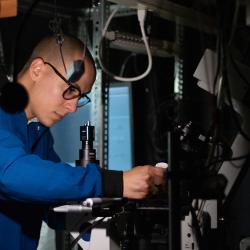
Chemistry and Biochemistry Assistant Professor Luis Ortiz-Rodríguez builds next-generation microscopes.
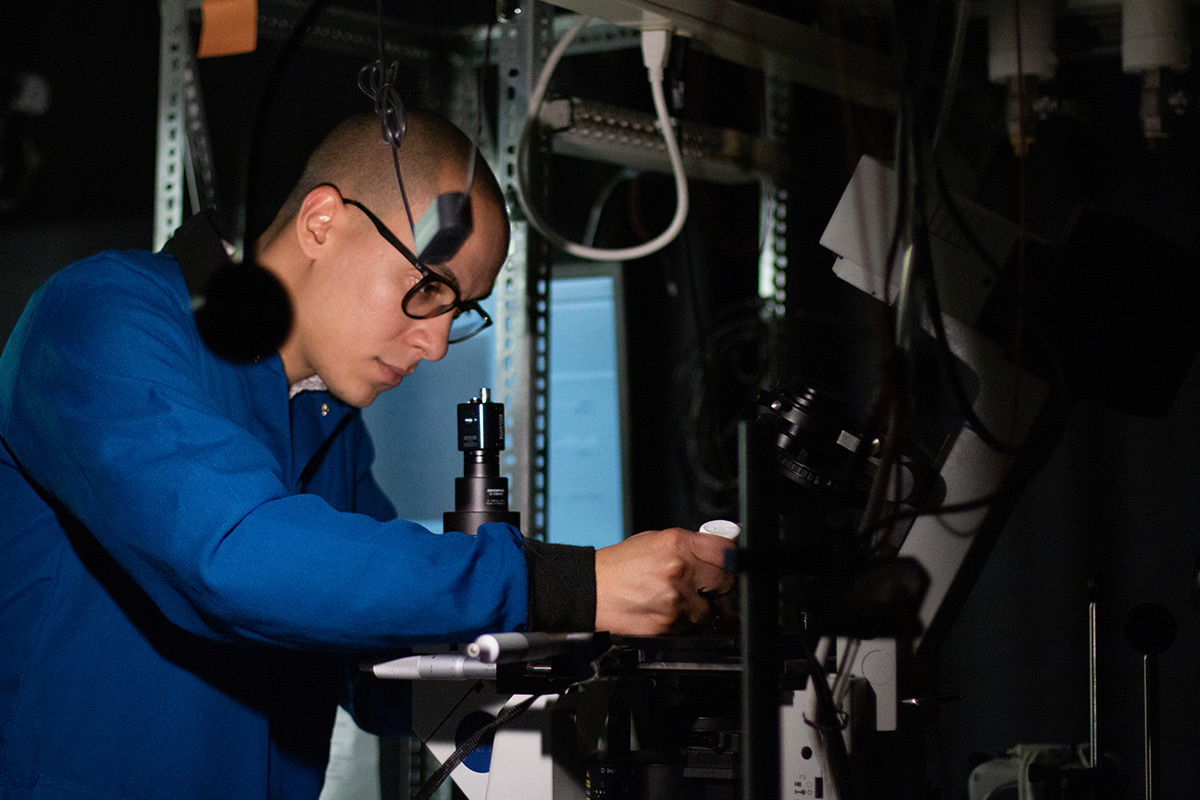
In his new lab at the University of Maryland, he researches how bacteria organize biochemical processes inside tiny cells. He’s especially interested in messenger RNA (mRNA)—molecules that carry assembly instructions from DNA to the cell’s protein factories. Scientists are still trying to understand how bacteria organize and control mRNA inside their cells—such as where these molecules travel after they are made, whether they move freely, whether they spend time in specific regions of the cell and how long they survive before being broken down.
Answering these questions has been difficult because bacterial cells are incredibly small, and watching individual RNA molecules inside them is a major technological challenge. Ortiz-Rodríguez's laboratory is developing advanced microscopes and new imaging approaches to observe these molecules in living bacteria. It is a challenging task, but if Ortiz-Rodríguez succeeds, the technique could transform what scientists know about how bacteria achieve biology’s central feat: turning genetic code into useful proteins.
“Bacteria are really small, so these measurements are really hard,” Ortiz-Rodríguez said. “But I like lasers, I like biology—and I’ve always liked a challenge.”
Falling in love with lasers
Growing up in Puerto Rico, Ortiz-Rodríguez was always curious. As he got older, he knew he needed to find a career path that would give him the flexibility to explore his evolving interests.
Early on, he thought he wanted to be a medical doctor. The interest sparked at a young age when his grandma got sick, and he wanted to understand her treatment plan. Because Ortiz-Rodríguez’s family didn’t have internet at home, he found encyclopedias to learn about chemotherapy and cancer medications. He followed his interest in medicine all the way to college, majoring in biology at the University of Puerto Rico at Humacao.
After freshman year, Ortiz-Rodríguez explored biological research. But spending hours making gels didn’t satisfy him. He always loved math, and he wanted to spend more time crunching numbers. So when a professor in the chemistry department told him they had a laser they hadn’t used in years, Ortiz-Rodríguez, ever curious, trained to use the device. That was when everything clicked.
“I fell in love with lasers,” Ortiz-Rodríguez said.
Ortiz-Rodríguez’s undergraduate advisor encouraged him to come to the continental United States to pursue a career in research. He completed a summer undergraduate research program working on lasers at Case Western Reserve University and decided to stay there for his Ph.D., focusing on physical chemistry and optics. But as he planned his next steps, he couldn’t help but feel that something was missing in his life.
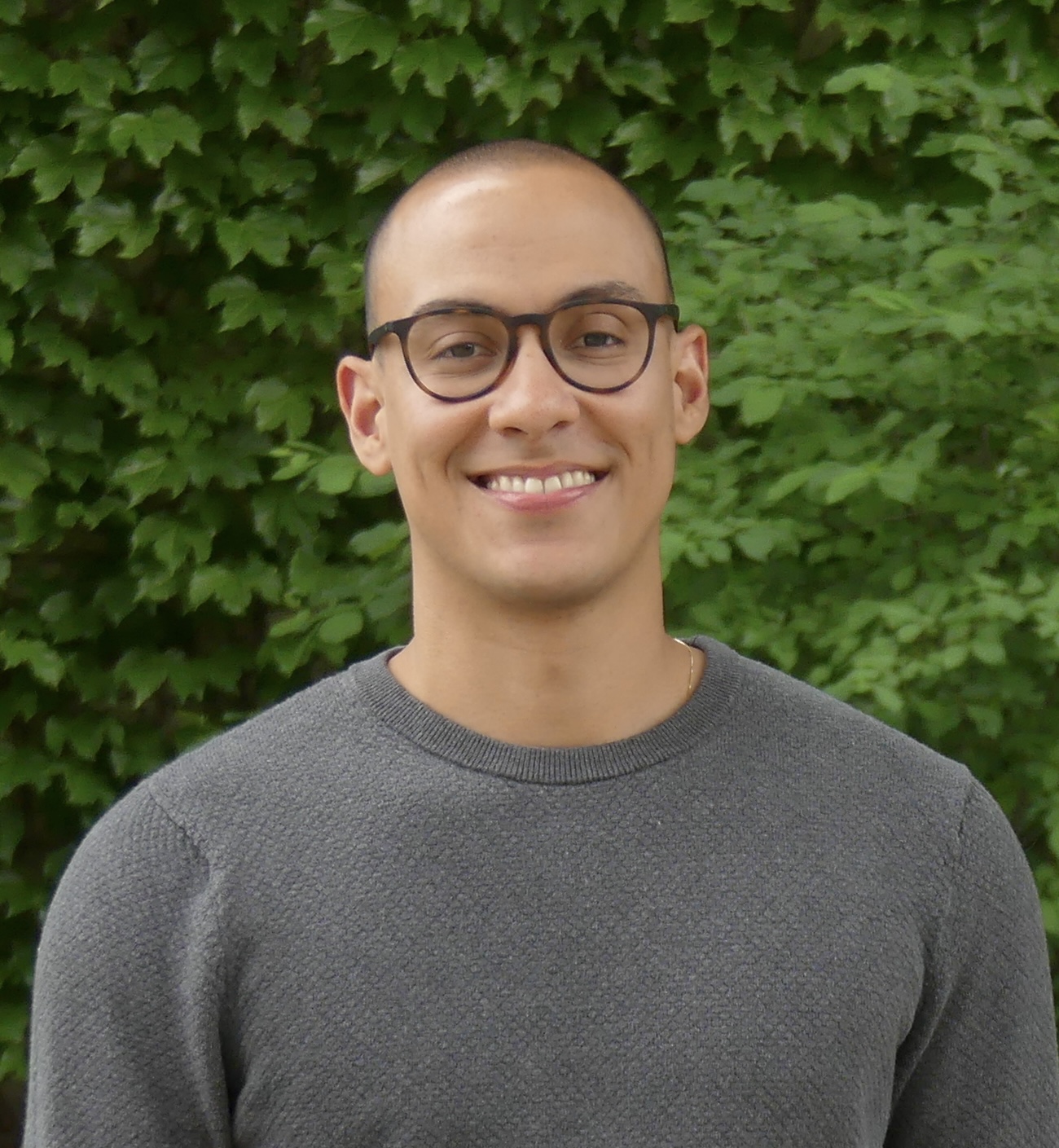
“Toward the end of the Ph.D., I realized that even though I liked lasers and optics, I missed biology,” Ortiz-Rodríguez said.
He wondered whether he could combine his quantitative expertise in lasers, optics and physical chemistry with his interests in biology. That’s when he decided to work on super-resolution, single-molecule microscopes for his postdoc.
Back to biology
After defending his Ph.D., Ortiz-Rodríguez joined Professor Julie Biteen’s lab at the University of Michigan. His research looked at how bacteria organize their internal biology and chemistry inside tiny cells. Unlike more complex organisms like animals, which organize many of their activities inside membrane-enclosed compartments called organelles, bacteria generally lack these structures. But that doesn't mean their interiors are disorganized. Bacteria have developed clever ways to organize their molecules without relying on membranes. One of these involves forming tiny clusters of proteins and RNA called biomolecular condensates, which bring specific molecules together to carry out important cellular functions.
Ortiz-Rodríguez was especially interested in a type of biomolecular condensate linked to the breakdown of mRNA called bacterial ribonucleoprotein bodies, or BR-bodies. His postdoctoral research showed that when a cell is growing, BR-bodies degrade mRNA, but under stress—such as starvation—they store it.
This remarkable switch is linked to changes in the physical properties of BR-bodies. When bacteria are actively growing, these structures behave more like liquids, allowing molecules to move around and interact. But when bacteria experience stress, such as a lack of nutrients, BR-bodies become more tightly packed and less fluid. This slows the movement of molecules inside them and helps protect mRNA from being broken down.
Now, in his research at UMD, Ortiz-Rodríguez wants to find out what happens to the mRNA molecules during that process. His prior work was made possible by a special microscope that allowed his team to track individual proteins in and around BR-bodies, but mRNA molecules are more challenging to track. They are sparsely distributed in an otherwise crowded cell—like needles in a haystack.
One major challenge is that scientists often need to attach fluorescent labels to RNA molecules to make them visible under a microscope. Some existing methods require relatively large modifications that can interfere with how RNA normally behaves—almost like asking a runner to compete while wearing a weighted vest.
“Your performance won’t be the same because you have a ton of weight on you,” Ortiz-Rodríguez said. “With labeled mRNA, you can see these beautiful patterns inside the cell, but we have to be careful because some labeling methods can alter how the molecules naturally behave. What we're trying to do is minimize those effects so we can observe what mRNA is actually doing inside living bacteria.”
To overcome these challenges, Ortiz-Rodríguez's laboratory is building highly specialized microscopes capable of detecting light from individual fluorescent molecules. By combining powerful lasers, sensitive cameras and sophisticated computer analysis, his team aims to follow individual RNA molecules as they move through living bacterial cells.
Unlike conventional microscopes, which cannot easily distinguish objects separated by extremely small distances, these systems will use super-resolution techniques to reveal molecular behavior at a much smaller scale. The microscopes are also being designed with interchangeable components, allowing the laboratory to incorporate new technologies as they become available.
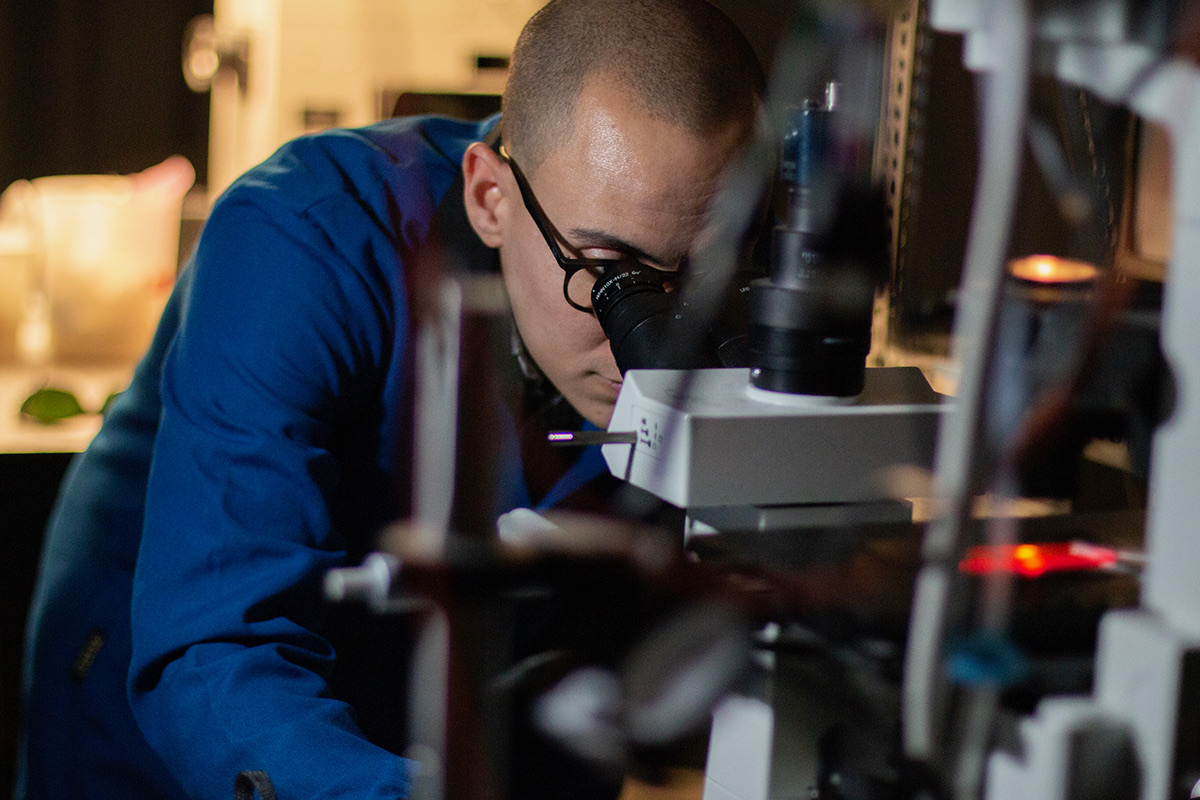
Beyond advancing bacterial cell biology, Ortiz-Rodríguez’s work has broader applications. For example, in his postdoctoral research, Ortiz-Rodríguez discovered that bacteria gain a fitness advantage from storing mRNA because many of the stockpiled molecules are necessary for recovery and regrowth. His lab will research how the switch to the solid, mRNA-storing state happens—and how it could potentially be stopped.
“If we can stop it, the bacteria could be easier to kill,” Ortiz-Rodríguez said. “This could lead to a new strategy for developing antibiotics.”
Building a new home at UMD
Ortiz-Rodríguez is recruiting biologists, biophysicists, physical chemists, engineers and computer scientists to work with him on this interdisciplinary research. The group will develop new instruments and pipelines to process data and provide expertise to understand the chemical kinetics and biological mechanisms behind mRNA metabolism.
While setting up his UMD lab, Ortiz-Rodríguez is enjoying everything that the Washington, D.C.-Maryland area offers his family. A hub for industry, the region provides plenty of job opportunities for his wife, a polymer scientist. And the couple’s 2-year-old daughter is already enamored with the metro subway system and visits to the museums in the nation’s capital. The region’s Latin American population is an unexpected plus.
“When we first visited here, we didn’t know that the Latin American population was so big,” Ortiz-Rodríguez said. “We want to make sure our daughter feels comfortable and accepted, and we really, really like how diverse this area is. When we got the offer to come to UMD, it was a no-brainer.”
As Ortiz-Rodríguez continues to lay down roots for his lab and his family, he’s keen to see how his UMD trainees develop.
“I know my students will do great, and I’ll be proud of them. But I’m eager to see how they become leaders in the group, going to conferences and representing the lab well. That’s something I get really happy thinking about,” he said. “They’re joining a lab with someone who is learning to be a professor. The fact that I have students who are willing to trust me—to trust the process—I’m very excited to see how I can reward the confidence that they have in me.”