



Education
- Postdoctoral Research Fellow, Chemistry, University of Michigan, 2022-2026; Advisor: Prof. Julie S. Biteen
- Ph.D., Chemistry, Case Western Reserve University, 2016; Advisor: Prof. Carlos E. Crespo-Hernández
- B.S., Biology, University of Puerto Rico at Humacao
Professional Experience
- Assistant Professor, Department of Chemistry and Biochemistry, University of Maryland, College Park, 08/2026 - Present
Research Interests
Bacterial RNA organization • Biomolecular condensates • mRNA localization and stability • Single-molecule fluorescence microscopy • Super-resolution imaging • Quantitative cell biology • Biophysical chemistry
Major Recognitions and Honors
- Michigan Pioneer Postdoctoral Fellowship, 2022-2026
- Charles F. Mabery Award for Best Thesis in Chemistry, 2022
- CWRU Graduate Teaching Award, 2020
- Northern Ohio AGEP Alliance Scholarship, 2017-2022
- Dumitru and George D. Mateescu Student Citizenship Award, 2019
Selected Publications
- Ortiz-Rodríguez, L. A.; Yassine, H.; Nandana, V.; Azaldegui, C. A.; Cheng, J.; Schrader, J. M.; Biteen, J. S. “Stress Changes the Material State of a Bacterial Biomolecular Condensate and Shifts its Function from mRNA Decay to Storage.” Nat. Commun., 2025.
Understanding RNA Organization in Living Bacteria
Revealing how individual mRNAs shape bacterial gene expression
Gene expression is not determined only by which genes are transcribed. After transcription, each mRNA enters a crowded and highly organized cellular environment where it can be translated, stored, or degraded. These competing outcomes shape how bacteria grow, adapt, and survive, yet the principles that determine mRNA fate remain poorly understood.
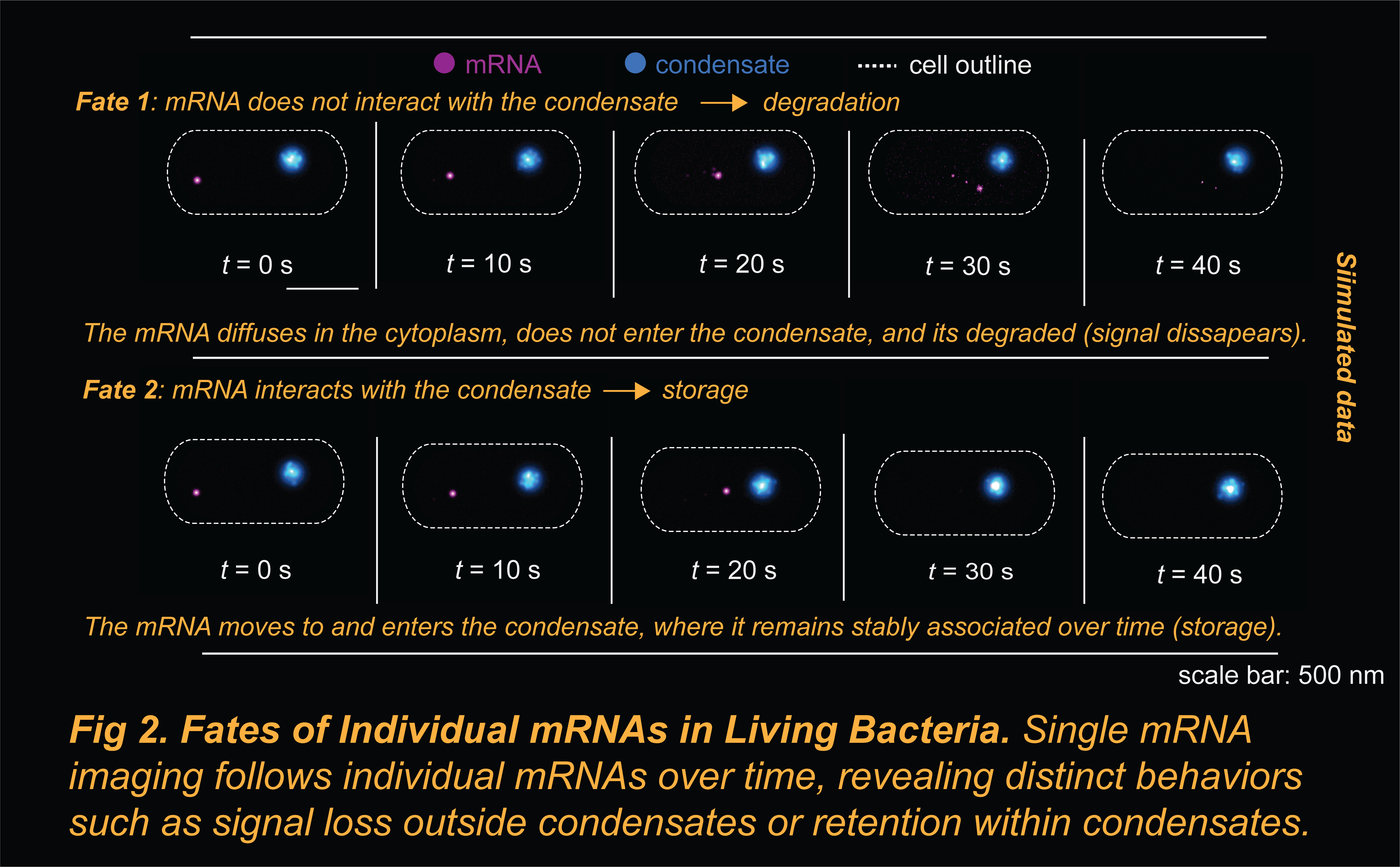
Much of what we know about bacterial RNA regulation comes from ensemble-average measurements or fixed-cell experiments. While powerful, these approaches often miss the dynamic and heterogeneous behavior of molecules inside living cells. The Ortiz Lab uses quantitative super-resolution microscopy and single-molecule imaging to bridge this gap. Super-resolution microscopy maps nanoscale organization beyond the diffraction limit (Figure 1), while
single-molecule imaging follows individual mRNAs over time to reveal how location, interactions, and environment influence fate (Figure 2).

Research Directions
Spatial organization of bacterial gene expression
Bacterial cells are small, crowded, and highly organized. Chromosomes, ribosomes, RNA-processing machinery, biomolecular condensates, and regulatory factors create intracellular environments that influence where mRNAs move and how they function. Our lab investigates how this spatial organization shapes gene expression during growth, stress, and adaptation.
RNA fate and biomolecular condensates
Every mRNA faces multiple possible outcomes. These decisions are shaped by ribosomes, RNA-binding proteins, RNA-processing enzymes, biomolecular condensates, and the physical organization of the cytoplasm. Our previous work showed that bacterial ribonucleoprotein bodies, known as BR bodies, can switch between distinct material states that alter their function and regulate RNA stability. Building from this discovery, we seek to understand how dynamic intracellular compartments influence RNA fate.
Single-molecule views of RNA regulation
Population-level measurements reveal average RNA abundance and stability, but individual mRNAs can follow very different trajectories. By observing single mRNAs in living cells, our lab aims to uncover how molecular motion, transient interactions, and condensate association relate to outcomes such as degradation or storage.
Vision
The Ortiz Lab aims to transform bacterial RNA biology from a field built largely on population averages into one where the life history of individual mRNAs can be observed directly inside living cells.