A Surprisingly Simple Way to Control Quantum Behavior
A new study from UMD chemical physicists could lead to more stable quantum memory, safer fuel storage and an improved ability to measure comet temperatures in outer space.
A new study from University of Maryland chemical physicists demonstrates how to control the nuclear spin of molecular hydrogen (H2) by simply freezing it in dry ice. This new technique, published in the journal Physical Review Letters on April 29, 2026, could improve energy storage for hydrogen fuel, memory for quantum computing and the ability to measure comet temperatures in outer space.
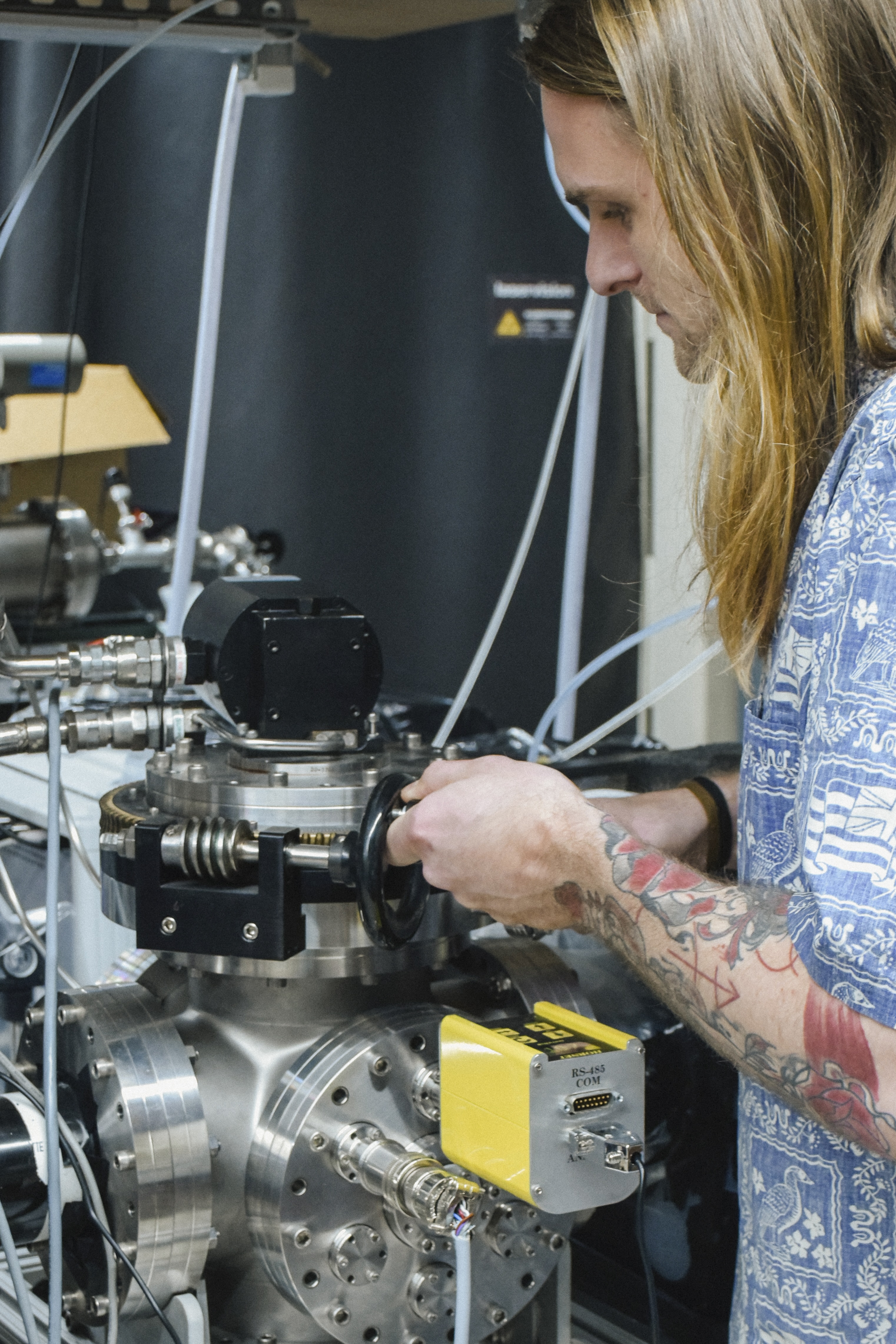
“Our paper demonstrates a new way to control quantum behavior using materials design alone,” said Leah Dodson, an assistant professor in UMD’s Department of Chemistry and Biochemistry and the paper’s senior author. “We show experimentally that when molecular hydrogen—the simplest molecule—is confined within different molecular crystals, the symmetry of the surrounding solid determines which quantum spin states can interconvert and which remain protected.”
Nuclear spin describes the angular momentum of an atom’s nucleus. Molecular hydrogen exists in two states: one where the nuclear spins of the two hydrogen atoms cancel out (para-H2) and one where they add up (ortho-H2). Ortho-H2 has three substates defined by the direction that the nucleus rotates.
When molecular hydrogen cools, ortho-H2 naturally wants to convert to its lower-energy state, para-H2, but the new study shows that freezing the substance in dry-ice crystals blocks this conversion for two substates of ortho-H2.
“The big finding is that, depending on what ice we put an H2 molecule into, its quantum dynamics are entirely dependent on the surrounding environment,” said Nathan McLane, a chemical physics graduate student and lead author of the paper.
The reason why is related to the geometry of crystalline dry ice. Its structure and symmetry impose “a set of ‘rules’ that H2 has to follow,” McLane said. The researchers found that these rules can be relaxed by introducing nitrogen dioxide into the crystal lattice, which changes the crystalline properties and enables all three ortho-H2 substrates to convert to para-H2.
Being able to control nuclear spin has broad applications, but until now it has required powerful magnetic fields or chemical catalysts. Because different quantum states of hydrogen require different amounts of energy to heat up, the U.S. Department of Energy, which funded the research, could more stably and efficiently store hydrogen fuel by enriching certain nuclear spin states of molecular hydrogen while protecting others. Next, Dodson and McLane will repeat this experiment with another fuel: methane.
Dodson added that molecular hydrogen releases heat when it converts from ortho to para. Fuel managers have to handle that heat safely and efficiently, she said, so they’re incentivized to understand how it gets produced.
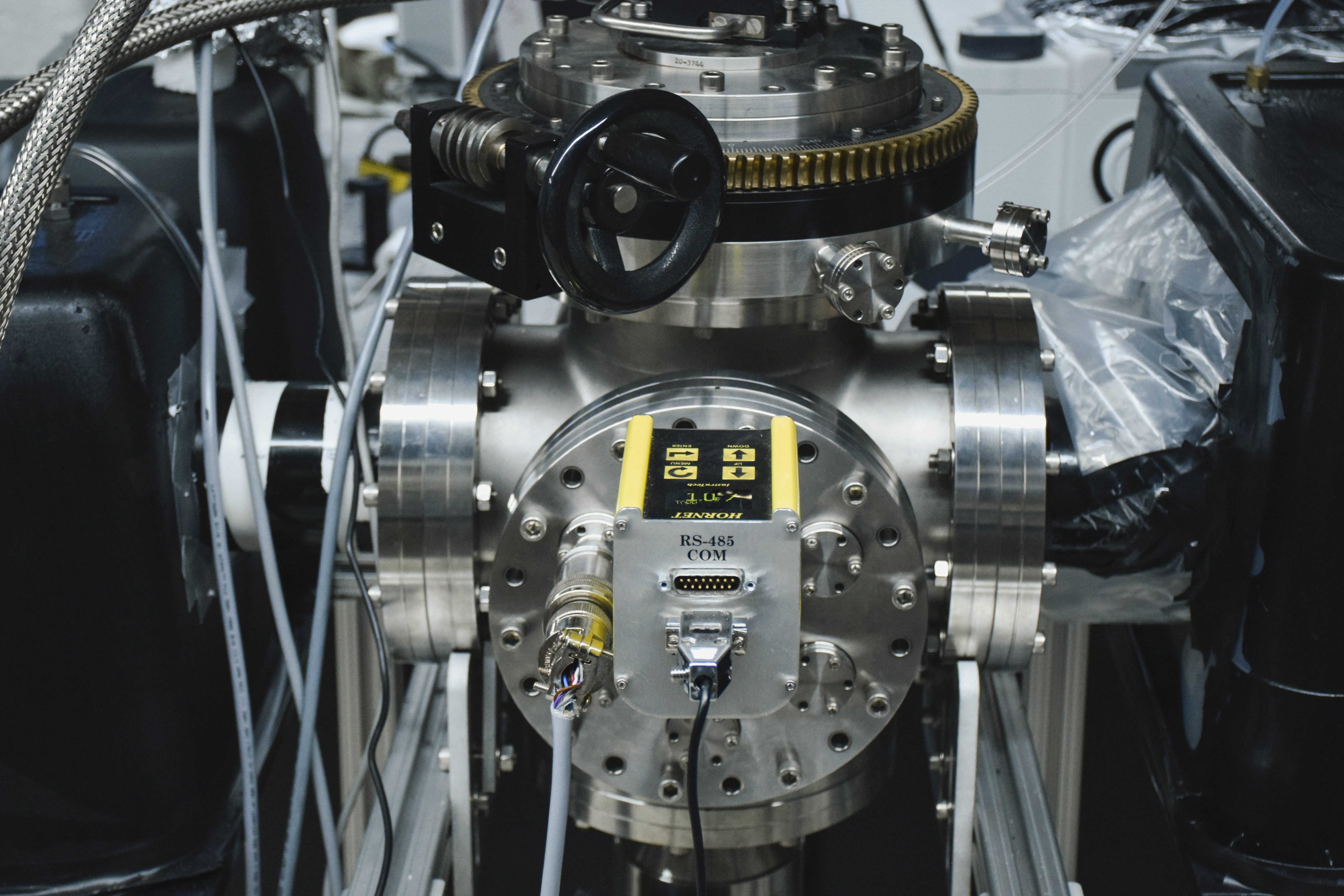
These findings could also improve astronomical measurements. Dodson, who also studies astrochemistry, explained that NASA measures the proportions of ortho and para water released from comets to estimate the temperature at which those comets formed. This calculation assumes certain unproven patterns about how nuclear spins change in comets; Dodson hopes to verify or refute those assumptions in the lab using this new approach.
Finally, being able to protect the quantum states of particles could lead to more stable forms of memory for quantum computing. These benefits could be substantial, McLane explained, because the experimental setup is so simple.
“Usually, quantum scientists have to do these very complicated experiments to actually get qubits,” McLane said. “But this is just H2 in dry ice.”
Although it’s unlikely that quantum scientists will make qubits with hydrogen frozen in dry ice, Dodson said that this landmark study lays the groundwork for more applied research.
“This work is setting out the foundational rules for how quantum states might become protected,” she said. “That’s where the impact is.”
###
UMD chemistry major LeAnh Duckett co-authored this article with McLane and Dodson.
The paper, “Environment-imposed selection rules for nuclear-spin conversion of H2,” was published in Physical Review Letters on April 29, 2026.
This research was supported by the U.S. Department of Energy, Office of Science Early Career Research Program, Office of Basic Energy Sciences under Award Number DE-SC0024262. This article does not necessarily reflect the views of this organization.