Mercedes Taylor and Michael Baptiste's Discovery Named UMD 2026 Invention of the Year (Physical Sciences)
University of Maryland Invention of the Year winners were announced Tuesday at Innovate Maryland, an annual celebration of UMD researchers’ creativity in translating cutting-edge research into practical, impactful solutions.
"Our researchers are redefining what's possible across science, medicine and technology," said Vice President and Chief Research Officer Patrick O'Shea. "From pulling 'forever chemicals' out of our drinking water to harnessing the power of quantum light, this year's finalists remind us that bold ideas and rigorous science can change lives and the world."
The 2026 Invention of the Year winners from the College of Computer, Mathematical, and Natural Sciences (CMNS) were:
Physical Sciences Category Winner
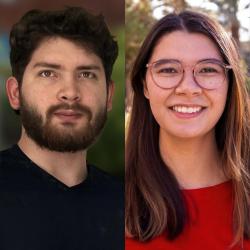
Rare-Earth Metal Ion Recovery Using a Self-Assembling Ligand System
Inventors: Mercedes Taylor and Michael Baptiste, Department of Chemistry and Biochemistry
The rare-earth metals used to build our phones, electric vehicles and renewable energy systems are extraordinarily difficult to recover and recycle. Traditional extraction methods are slow and chemically intensive and often yield impure results. Researchers in the College of Computer, Mathematical, and Natural Sciences have designed a molecule that solves this problem by self-assembling around rare-earth ions to selectively bind and separate them from complex mixtures. The process is rapid, recyclable and precise, with the potential to build a more sustainable and reliable supply chain to support clean energy infrastructure.
Quantum Technology Category Winner
Topological Photonics Architecture for Optical Computing and Artificial Intelligence (TOPAI)
Inventors: Mahmoud Mehrabad, Lida Xu, Supratik Sarkar, Zhi-Yuan Wei, Mohammad Hafezi, Department of Physics
Today’s AI systems are bumping up against hard limits. They consume enormous amounts of power, generate tremendous heat and struggle to scale. TOPAI, developed by researchers in the College of Computer, Mathematical, and Natural Sciences and the A. James Clark School of Engineering, offers a different approach: computing with light instead of electricity. Like a train locked onto a track, TOPAI’s topological photonic states keep information stable and on course even as the system scales, opening a new frontier for AI infrastructure that is faster, cooler and more resilient than ever before.
In addition, Anne Simon, a professor of cell biology and molecular genetics, received a special recognition award for her significant contributions to UMD's innovation ecosystem. Simon received the Innovation Catalyst Award for spurring innovation on campus and in industry. Simon co-founded Silvec Biologics with her brother Rafael Simon to deploy her research against citrus greening disease—a bacterial infection that has devastated Florida's citrus industry since 2005 and continues to threaten production worldwide.
The following CMNS discoveries were finalists for Invention of the Year:
Life Sciences Category Finalist
Early Detection of Alzheimer's Disease Using a Quantum Biosensor
Inventors: Kan Cao, Department of Cell Biology & Molecular Genetics, and Cheng Gong, Department of Electrical and Computer Engineering
The invention is a non-invasive approach for identifying early Alzheimer’s disease risk signatures, both in vitro and in vivo, using quantum biosensors. Unlike existing methods, this approach can detect elevated Alzheimer’s disease risk at very early, pre-symptomatic stages, potentially years before overt clinical decline. This enables prevention, stratification for clinical trials and early intervention.
Physical Sciences Category Finalist
Broken Plasma Channel LWFA Injector
Inventors: Jaron Shrock, Scott Hancock, Nishchal Tripathi, Ari Sloss, Bo Miao, Howard Milchberg and Ela Rockafellow, Institute for Research in Electronics & Applied Physics, Department of Physics, and Department of Electrical and Computer Engineering
This technology enables precise, tunable electron injection in laser-driven particle accelerators, producing high-energy, tightly focused electron beams with exceptional control. By using an advanced laser technique to momentarily modify the plasma channel, the system delivers beam quality suitable for real-world deployment rather than laboratory demonstration. These capabilities directly support high-value applications including free-electron lasers, next-generation particle colliders, and advanced semiconductor lithography, where precise electron control is critical for achieving higher resolution, efficiency and scalability.
Quantum Technology Category Finalists
Squeeze Quantum Light on a Chip for Device Integration
Inventors: Avik Dutt, Yichen Shen, Ping-Yen Hsieh, Institute for Physical Science and Technology and Department of Mechanical Engineering
This technology is a chip-based, frequency-tunable squeezed light source that generates strong, multi-mode quantum light for enhanced sensing and spectroscopy, enabling more sensitive measurements at lower power and scalable quantum information processing on an integrated photonic microchip platform.
Fiber-Based Quantum Sensing Platforms
Inventors: Fahad Shaikh, Wolfgang Losert, Min Ouyang, Department of Physics and Institute for Physical Science and Technology
This technology delivers a fully integrated, fiber-based quantum sensing probe that enables remote, minimally invasive and high-sensitivity measurements in environments where conventional quantum sensors cannot operate. It brings laboratory-grade quantum sensing into liquid, confined and in vivo settings using a compact, deployable fiber architecture.
Adapted from an article written by Silvana Montañola