Many Hands Make Light Work: Ph.D. student Mya Gaddy uses light to build synthetic molecules for drug development
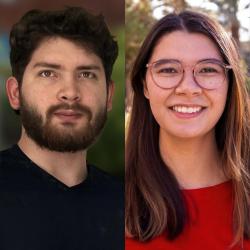
In the lab, chemistry Ph.D. student Mya Gaddy uses light to build synthetic molecules for drug development. She also supports her peers as vice president of UMD’s Chemistry and Biochemistry Graduate Student Organization.
University of Maryland chemistry Ph.D. student Mya Gaddy spent weeks trying to figure out why her chemical reactions worked at a small scale but failed when she tried to reproduce them at a larger scale.

Finally, after much trial and error, Gaddy realized that it wasn’t her technique or chemistry knowledge that hindered the experiments—the issue turned out to be the distance between a lamp and a test tube.
“I got a major boost in my yield just by moving the lights closer to the sample,” Gaddy said. “You can spend all this time optimizing on a small scale, perfecting every fine detail. In a perfect world, maybe these techniques can just be reproduced and work, but that’s unfortunately not how it works in real life.”
It’s a lesson in patience that Gaddy continues to appreciate as she conducts research in the laboratory of Benjamin Boyle, an assistant professor of chemistry and biochemistry at UMD. In the Boyle lab, where light is both the tool and the variable, the margin between success and failure can be as thin as a few inches.
Boyle’s group focuses on beta-amine functionalization—a technique for modifying a precise location on a molecule without disturbing anything around it, much like replacing a single rivet on a bridge while leaving the rest of the structure intact. Using what they call an antenna approach, the researchers chemically protect the molecule’s amine group (nitrogen atoms bonded to carbon or hydrogen atoms) while using an “antenna” to reach in and make targeted changes through different chemical pathways.
Gaddy’s project applies this methodology to amino acids, the basic building blocks of all proteins. Her goal is to engineer unnatural amino acids using light to shape them. By shining a light on compounds derived from amino acids, Gaddy can energize specific bonds between nitrogen and carbon atoms inside a protected molecule—creating a state of tension that primes the molecule to work in chemical reactions that would otherwise be difficult or impossible to trigger.
“In practical terms, these unnatural amino acids can be incorporated into drug development pipelines, used to engineer new proteins or applied to biological imaging,” Gaddy explained. “We’re doing very fundamental research that can be used to improve the drug development process, enabling next-generation treatments and techniques.”
A culture of collaboration and community
When Gaddy arrived at UMD in fall 2024 after graduating from Lafayette College in Pennsylvania with bachelor’s degrees in chemistry and German, Boyle’s lab was still very new.
“The most experienced students in the lab were first-years at the time, so it felt like we were all starting everything from scratch together,” Gaddy said. “We were all learning from each other at once.”
That dynamic shaped how she approaches problems in the lab. Collaboration in Boyle’s group doesn’t look like a senior researcher guiding a junior one through an established protocol. For Gaddy, it looks more like a group of people encountering the same unknowns from different angles, pooling insights whenever they figure something out.
“We’re split into two teams working with different starting materials. My team works with benzoxazinones,” Gaddy explained. “But when someone develops a technique that works, they share it. We collaborate a lot in that sense, always checking in to see what the other group is doing and whether there’s something we can learn from it.”
Boyle noted that Gaddy’s collaborative spirit extends well beyond the science.

“She brings curiosity, persistence and a positive attitude to her work,” he said. “She has a notably positive impact on our group culture through her supportive approaches.”
Gaddy brings that same community mindset to her role as vice president of the Chemistry and Biochemistry Graduate Student Organization, where she helps plan social events, from movie nights and potlucks to student orientations and seminars.
“Last year, when [Chemistry and Biochemistry Professor Amy Mullin] approached our cohort about reviving the dormant graduate student org, I raised my hand,” Gaddy recalled. “I was one of the few people at the time to volunteer, and it’s been great supporting the incoming grad students who need advice and guidance like I did when I first got here.”
For Gaddy, helping graduate students find a chance to swap stories about research and personal interests is immensely satisfying; sometimes, they can even lead to breakthroughs like the one she had with her light experiments. It’s also helped her build confidence in science communication—talking with peers who share her passion has made the public speaking aspects of her research less intimidating.
“It’s something I’m actively working on, since I know I struggle with presentations sometimes,” said Gaddy, who led a seminar in March 2026. “Standing up in a room full of people and explaining my work doesn’t come naturally yet, but it’s gotten better with some practice and support.”
What’s next
For Gaddy, the destination has always been clear: a career in the cosmetics industry.
After graduating, she hopes to carry her synthetic chemistry training into fragrance formulation. Although the connection between cosmetics and pharmaceutical drug development may not seem immediately obvious, Gaddy says that building a new scent molecule requires the same precise, iterative construction she practices every day in the lab. The skills and experience transfer directly, something she hopes will give her a leg up in the industry.
“I’d like to eventually work with formulation-focused things in cosmetics, including fragrance development,” Gaddy said. “My time here at UMD has shown me that I have to think a little outside the box for many of the things I plan to do—and that’ll take me wherever I need to go.”