Explore the Chemistry of Food with Senior Lexi Chiu
The double-degree student in chemistry and nutrition and food science finds connections between the lab and the kitchen.
There’s a saying that baking is a science, and cooking is an art. As a lifelong baker, University of Maryland senior Lexi Chiu sees some truth to that.
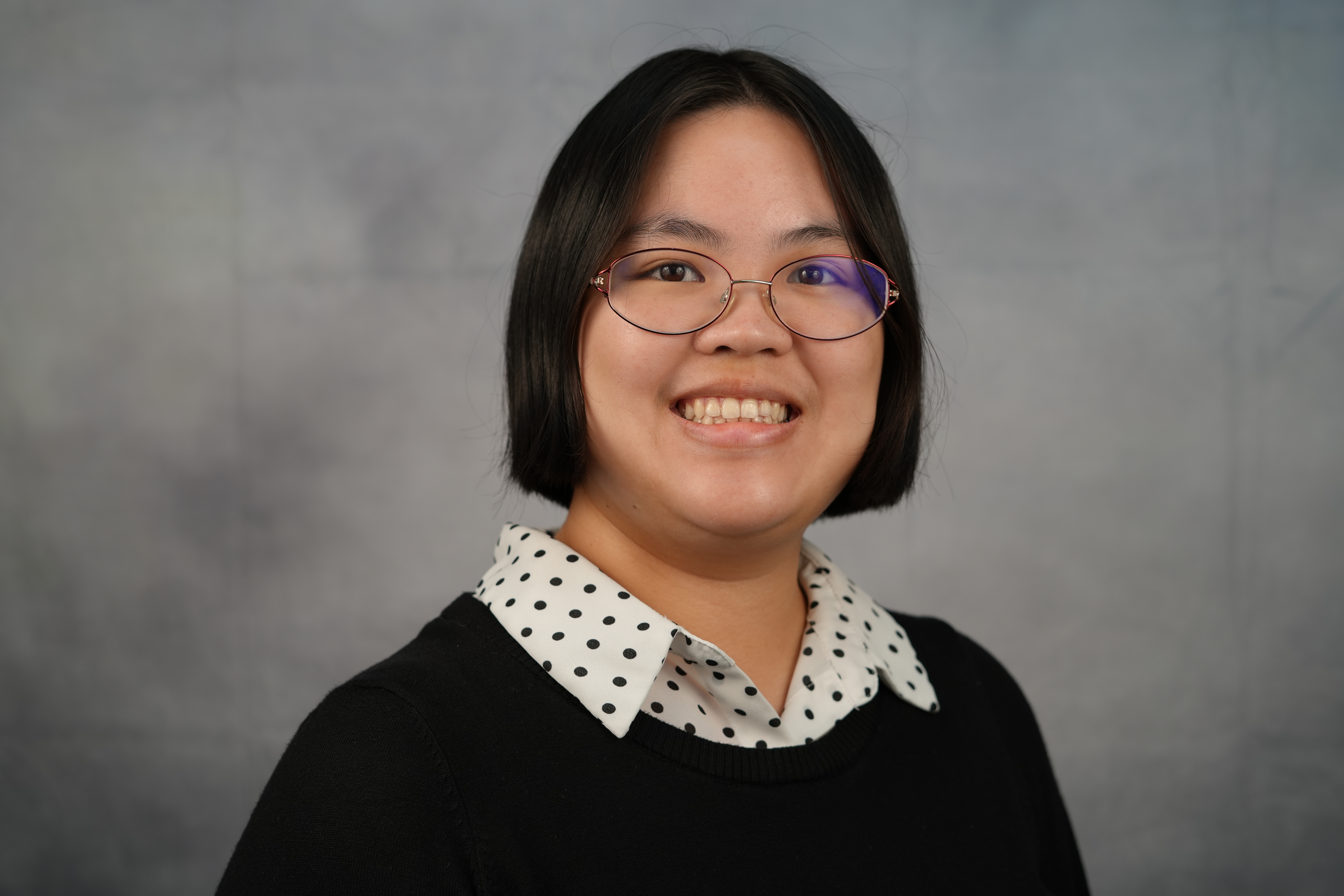
“In chemistry, if you add a little bit too much of a reagent, it could all not work out,” Chiu said. “Comparing that to cooking, I feel like you can add a little more of this or a little more of that, and it will generally turn out pretty well.”
That’s true even for bakes as simple as chocolate chip cookies, Chiu said. She once ran a bake sale for the Food Science Club, of which she is executive vice president. Several peers helped make cookies, and there was a huge variation in the outcomes.
“One group basically just tossed in everything at once, and that did not work,” she said. “There was melted butter, so it just melted everything.”
Thinking about the science of food is more than just a hobby for Chiu. As a double-degree student in chemistry and nutrition and food science, it’s her academic and career path. Fun as it sounds, it’s also grueling. A double degree requires 150 credits—30 more than a double major or a single degree—and there is little overlap between her two programs. Plus, chemistry and food science classes often require labs; in some semesters, Chiu took three lab courses at once.
It’s been “a tough road,” Chiu said. But, like a confection coming out of the oven after hours of culinary labor, she thinks the hard work will pay off as she pursues a career developing food with the power of science.
The rise of science-based cooking
Growing up in Herndon, Virginia, Chiu has fond memories of baking cupcakes with her mother. By the time she was in high school, she had become her household’s main baker. Now, she makes more advanced recipes—and the more challenging the task, the more she thinks about science.
Take French macarons—one of Chiu’s recent go-to recipes.
“Those are really difficult. I frequently joke that if you breathe on them wrong, they will not turn out well,” Chiu said.
The recipe—not unlike a precise scientific formula—involves whipping egg whites and sugar into a protein matrix that perfectly holds air and moisture, ensuring no yolk enters the mix and disrupts the protein structure, and baking at just the right temperature to let the trapped air rise, forming cookies with smooth, domed caps.
These days, chefs and food content creators are more focused than ever on the chemistry of cooking. One of Chiu’s favorite culinary personalities is Benjamin Delwiche (who uses the online username benjaminthebaker), a full-time math teacher who posts videos of baking experiments, such as leavening breads with yeast, sourdough starter or baking soda, or adding different types of chocolate to chocolate chip cookies.
Thanks to the popularity of internet foodies, public interest in food science has reached record heights, to the point that chefs might mention a complex chemical process known as the Maillard reaction—the famous “browning reaction” through which sugars and amino acids mingle to form a rich tapestry of new flavors and aromas—with little added explanation. That’s one of many food chemistry concepts that Chiu has encountered in both of her degree programs.
Because few students at Maryland pursue degrees in both chemistry and nutrition and food science, Chiu is hopeful that taking this path will help her stand out in the job market.
She pointed to Kristi Kan (B.S. ’18, chemistry and nutrition and food science), who now works as a food scientist developing yogurt products for one of the country’s biggest yogurt producers. Chiu hosted her as a guest speaker at a Food Science Club event, where she shared her expertise in yogurt production and gave attendees the opportunity to taste-test products.
“I think the students found it pretty interesting because a lot of them probably hadn’t thought deeply about what texture they like their yogurt,” Chiu said. “And it was the best of both worlds because you got some education, and you got to try some food.”
After graduating, Chiu also hopes to pursue a career in food product development, building on her 2024 experience as a research and development intern at Colgate, where she worked on the chemistry of oral care products such as toothpaste.
“I did a bit of research looking at what’s commonly done in other companies and what people like in their toothpastes from looking at social media. Then, I would go to the lab and test things out,” she said.
It wasn’t food science, Chiu noted—as product labels warn, people should not eat toothpaste. But she sees the skills—including chemistry techniques such as sample preparation, sanitation, fluorescence and spectroscopy—as transferable to food science. And while she can see herself returning to a pure chemistry lab at some point, “food science is where my passion lies,” she said.
From successful baking to yogurt making, for Chiu, the unique benefits of food chemistry are hard to resist. After all, who can say no to a sweet treat after a long day of science?