U.S. National Science Foundation workshop Lead Organizer Tiwary is Building Better AI for Chemistry
A U.S. National Science Foundation workshop hosted by the University of Maryland began charting a roadmap for developing chemistry-specific artificial intelligence tools to advance scientific research and discovery.
More than 50 experts from academia, government and industry gathered at the University of Maryland in September to explore how artificial intelligence could accelerate chemical research and discovery while making it more reliable and reproducible. Funded by the U.S. National Science Foundation, the two-day workshop focused on creating a shared vision for chemistry-first AI—tools and infrastructure designed around the field’s distinctive data, scientific questions and experimental practices.
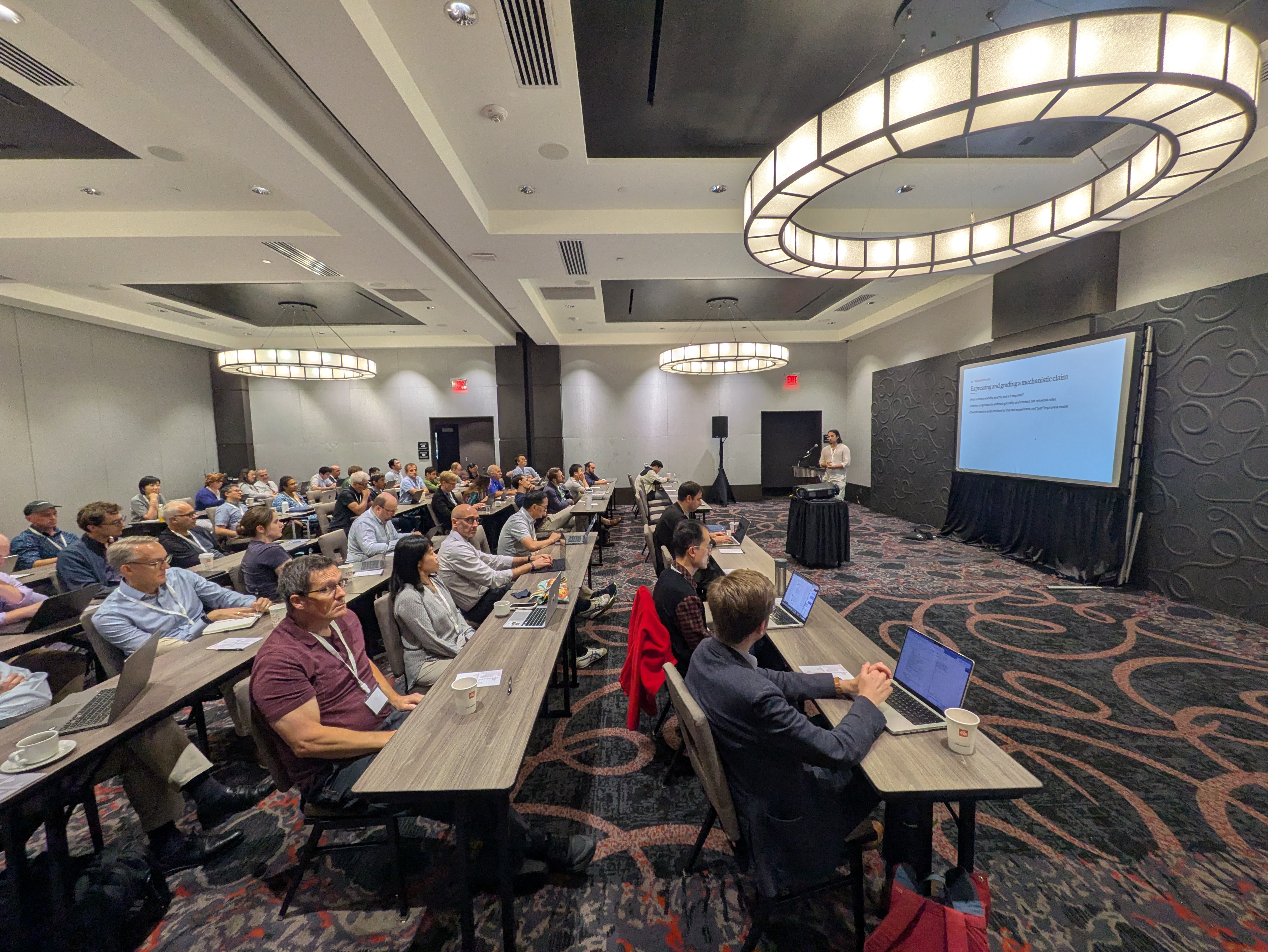
“Chemistry is a demanding environment for AI development, as our data tend to be scattered across instruments, papers, simulations, scales, repositories and more,” said the workshop’s lead organizer Pratyush Tiwary, a professor in UMD’s Department of Chemistry and Biochemistry and Institute for Physical Science and Technology (IPST), and director of therapeutic drug discovery at the University of Maryland Institute for Health Computing (UM-IHC). The Department of Chemistry and Biochemistry, IPST and UM-IHC provided additional support for the workshop.
With a focus on the practical challenges of developing and evaluating AI for chemistry, the workshop brought together participants with expertise in chemical theory, molecular simulation, AI, machine learning, data curation and publishing. They explored how to organize a wide range of chemical data so that AI tools can use it effectively and reliably to discover new molecules, materials and chemical processes.
While AI methods are already accelerating chemical discovery, workshop participants emphasized the need for greater precision and for chemical data to be more useful across laboratories and subfields. They also discussed how to evaluate AI systems for trustworthiness and how to balance open-data goals against the commercial value of data, models and workflows.
The participants are now writing a community-facing report outlining priorities for the field and identifying pilot projects that could begin within one to two years.
“Building AI specifically for chemistry takes a shared vision across a range of stakeholders,” said Tiwary, who also holds the Millard and Lee Alexander Professorship in Chemical Physics at UMD. “Together, our long-term objective is to make experimental and computational chemical data, models and tools more accessible, searchable, interoperable and shareable. This gathering and the resulting community roadmap will help us move in that direction.”
###
This event was funded by the U.S. National Science Foundation (Award No. 2630156). This article does not necessarily reflect the views of this organization.