

Education
- Ph.D. in Chemistry, Department of Chemistry, Purdue University, 2020; Ph.D. Advisor:
Prof. Philip S. Low - B.S. in Pharmacy, School of Pharmaceutical Science, Shandong University, 2013;
Undergraduate Research Advisor: Prof. Xinyong Liu
Professional Experience
- Assistant Professor, Department of Chemistry and Biochemistry, University of Maryland,
College Park, 08/2026-Present - Instructor, Program in Cellular and Molecular Medicine, Boston Children's Hospital and
Harvard Medical School, 2025/05-2026/08; Faculty Mentor: Prof. Hao Wu - Postdoctoral Fellow, Program in Cellular and Molecular Medicine, Boston Children's
Hospital and Harvard Medical School, 2020/06-2025/05; Postdoctoral Advisor: Prof.
Hidde Ploegh
Research Interests
Chemical Biology, Medicinal Chemistry, Protein Engineering, Antiviral Research, Cancer Immunotherapy, and Ligand-Targeted Therapeutics and Molecular Imaging
Major Recognitions and Honors
- Henry Bohn Hass Memorial Fellowship, 2019
- Travel award for 32 nd International Conference on Antiviral Research (ICAR), 2019
- First prize in graduate student category, 32 nd International Conference on Antiviral Research (ICAR) poster award, 2019
Selected Publications
- Liu, X.; Le Gall, C.; Alexander, R. K.; Borgman, E.; Balligand, T.; Ploegh, H. L. Nanobody-based bispecific antibody engagers targeting CTLA-4 or PD-L1 for cancer immunotherapy. Nature biomedical engineering 2026, 10 (1), 39-55.
- Liu, X.; Goldberg, E.; Kagan, J. C.; Wu, H. Igniting antitumour immunity with cancer cell pyroptosis. Nature Reviews Cancer 2026, DOI: 10.1038/s41568-026-00959-3.
- Liu, X.; Balligand, T.; Le Gall, C.; Ploegh, H. L. A monoclonal anti-hemagglutinin stem antibody modified with zanamivir protects against both influenza A and B viruses. Proceedings of the National Academy of Sciences 2025, 122 (15), e2424889122.
- Liu, X.; Balligand, T.; Carpenet, C.; Ploegh, H. L. An armed anti-immunoglobulin light chain nanobody protects mice against influenza A and B infections. Science immunology 2023, 8 (84), eadg9459.
- Pishesha, N.; Harmand, T.; Carpenet, C.; Liu, X.; Bhan, A.; Islam, A.; van den Doel, R.; Pinney III, W.; Ploegh, H. L. Targeted delivery of an anti-inflammatory corticosteroid to Ly6C/G-positive cells abates severity of influenza A symptoms. Proceedings of the National Academy of Sciences 2022, 119 (43), e2211065119.
- Liu, X.; Zhang, B.; Wang, Y.; Haymour, H. S.; Zhang, F.; Xu, L.-c.; Srinivasarao, M.; Low, P. S. A universal dual mechanism immunotherapy for the treatment of influenza virus infections. Nature communications 2020, 11 (1), 5597.
Our research is rooted in chemistry, with an emphasis on synthetic chemistry, medicinal chemistry, and protein engineering to create new research tools, therapeutic modalities, and diagnostic agents. We integrate bioengineering, immunology, and animal models to investigate the mechanisms of our molecules, optimize their function, and evaluate their therapeutic potential. Our studies use synthetic small molecules and nanobodies, the recombinantly expressed variable domains (VHHs) of heavy chain only antibodies that are one tenth the size of conventional antibodies, highly stable, and easy to engineer. Our research advances three complementary strategies for developing chemical biology probes, targeted therapeutics, and diagnostic agents.
Strategy 1, Design of Ligand-Targeted Drugs
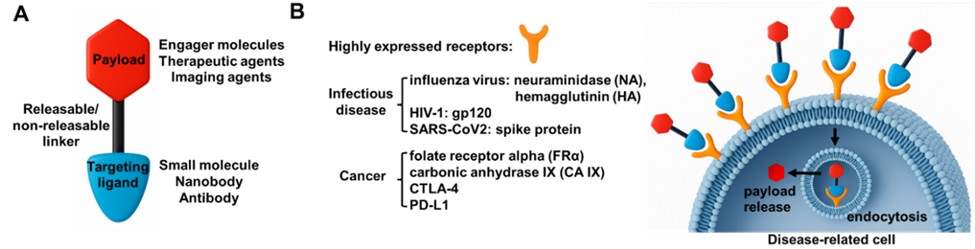
Systemically administered therapies often fail to distinguish between diseased and healthy tissues, resulting in off-target toxicity and limited efficacy. Our research explores how disease-specific surface markers can be exploited to overcome this challenge, both to improve the precision of drug delivery and to gain insight into how these markers can be harnessed therapeutically. We develop small molecule- and nanobody-based ligands that bind selectively to disease-associated surface markers. These ligands are conjugated to therapeutic or imaging payloads to promote their preferential accumulation in marker-positive cells and tissues while reducing exposure to healthy cells. Our ligand-targeted drugs and imaging agents have applications in infectious diseases, particularly influenza, and cancer.
Strategy 2. Development of New Therapeutic Modalities
We apply ligand-targeted principles to develop bispecific and multispecific therapeutic modalities that engage T cells, innate immune cells, or endogenous antibodies. We also explore how ligand targeting can be incorporated into protein degraders, immune modulators, and other emerging therapeutic platforms.
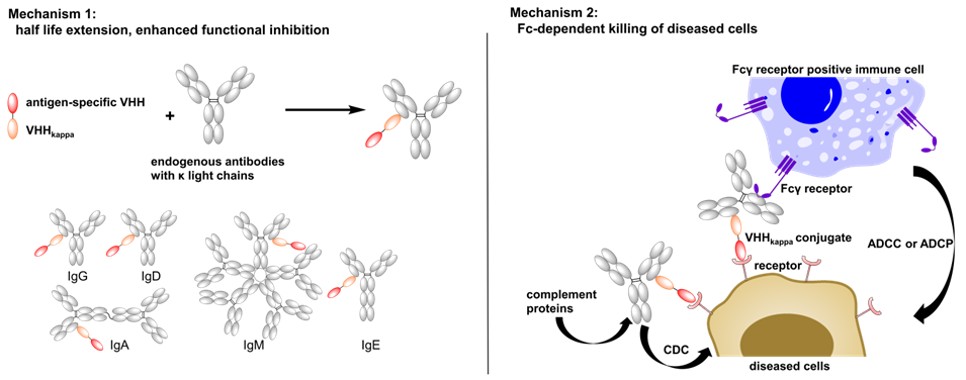
One ongoing project focuses on bispecific anti-immunoglobulin kappa light-chain nanobody conjugates, termed VHH kappa conjugates. VHH kappa binds the constant region of kappa light chains, which are present in approximately 60% of human immunoglobulins. We demonstrated that recruitment of abundant endogenous immunoglobulins can confer antibody-like properties on otherwise short-lived therapeutic molecules. This modular approach enables small molecules, peptides, or nanobody inhibitors to be converted into antibody-like therapeutics through fusion or conjugation to VHH kappa . A distinguishing feature of this strategy is its ability to recruit diverse Fc-mediated functions from multiple immunoglobulin isotypes, including IgG-mediated antibody-dependent cellular cytotoxicity (ADCC) and phagocytosis (ADCP), IgA-associated mucosal transport and immunity, and potent IgM-mediated complement activation (CDC).
Strategy 3. Development of non-invasive Molecular Imaging Agents
Noninvasive molecular imaging enables the distribution and behavior of malignant cells, immune cells, and disease-associated biomarkers to be monitored throughout disease progression and treatment. We conjugate marker-specific small molecules, peptides, and antibodies to fluorophores or radioisotopes for fluorescence imaging or positron emission tomography (PET), respectively. These approaches provide whole-body visualization of specific biological markers in living animals and help elucidate disease mechanisms, support diagnosis, and guide the development of ligand-targeted therapies.
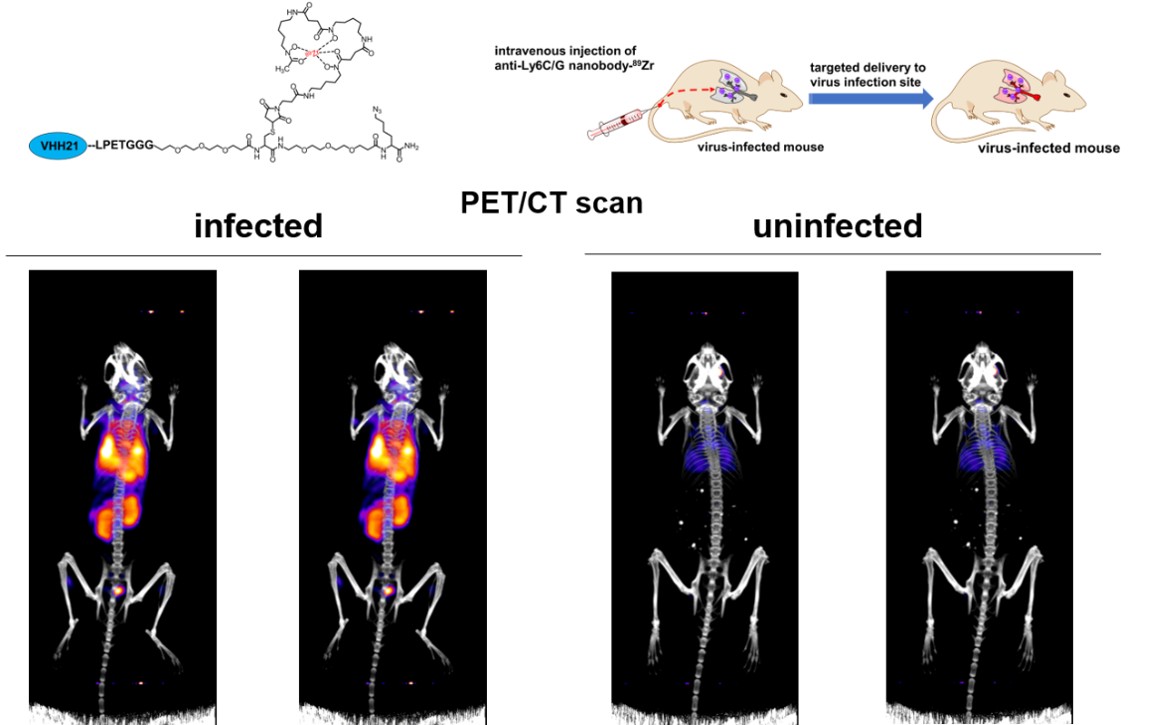
As one example, we developed a zirconium-89-labeled nanobody targeting Ly6C/G, markers expressed by neutrophils and other myeloid cells. Using PET imaging, we detected extensive immune-cell infiltration into the lungs during the early stages of influenza infection. These findings subsequently guided the development of Ly6C/G-targeted delivery of anti-inflammatory agents using the same nanobody to alleviate infection-associated hyperinflammation